Tennis Performance Guide

COURT
IQ

From stroke mechanics to match-day mindset — practical, cue-driven guidance for competitive players who want to perform under pressure, not just in practice.

01 — Stroke Technique

Every Stroke, Broken Down

The 8 fundamental shots in tennis — what they are, how to hit them, and the common mistakes that break them down under pressure.

Forehand Groundstroke

Your primary weapon from the baseline. A kinetic chain from feet to shoulder — when each link fires in sequence, the shot almost makes itself. The goal is consistent topspin contact out in front with a stable, full finish.

Semi-Western / Eastern grip Low-to-high swing path Topspin Open or neutral stance

Step-by-Step

  1. Grip: Semi-western is the modern standard — index finger knuckle on bevel 4. Generates topspin naturally.
  2. Preparation: Turn shoulders and hips early. Racket back before the ball bounces on your side. Non-dominant hand on throat for guidance.
  3. Stance: Neutral / closed for controlled attack. Open stance for wide balls and explosive recovery — but avoid it when you have time to step in.
  4. Contact point: Out in front of your lead hip, at waist height ideally. Arm slightly bent, not fully extended.
  5. Swing path: Drop the racket head below the ball, then accelerate low-to-high through contact. Brush up the back of the ball to create topspin.
  6. Follow-through: Racket finishes high over the opposite shoulder. Full extension through the ball — no early braking.
  7. Recovery: Push off and reset to center immediately after contact.

Key Principles

  • Eyes track ball from opponent's racket all the way through your contact point
  • Load your legs before you swing — power comes from the ground up
  • Weight forward at contact — leaning back opens the face and sails balls long
  • Consistent topspin gives you net clearance and depth margin — the safety net for aggressive swings
  • Shorten backswing when time is short (return of serve, fast incoming ball)
  • Stable finish = proof that setup was right. Falling off = setup was wrong

⚠️ Common Mistakes

  • Ball sailing long or wide right: Racket face open at contact, or swing path too flat — brush up more aggressively
  • Dunking into the net on high balls: Dropping swing path below the ball and not brushing up through it
  • Inconsistency under pressure: Early hip rotation / excessive open stance causing late contact — step in and close stance when time allows
  • Over-relying on wrist: Power and consistency come from the whole kinetic chain, not wrist snap

Backhand Groundstroke

Often the more consistent side once technique is sound — less reliant on timing than the forehand. Two-handed offers power and control; one-handed offers reach and disguise. Slice is your third option and a critical change of pace weapon.

Two-handed: Continental + Eastern FH One-handed: Eastern BH grip Slice: Continental grip

Two-Handed Topspin

  1. Grip: Dominant hand continental (like holding a hammer), non-dominant hand eastern forehand on top. Non-dominant hand drives the shot.
  2. Preparation: Turn shoulders fully — more than feels natural. Racket back with both hands, upright position behind you (not horizontal, which creates flat shots).
  3. Stance: Closed stance for power. Step across with your front foot for controlled drives.
  4. Contact: Out in front of the body, at comfortable height. Pronate the wrist through contact to generate topspin.
  5. Swing path: Low to high, brushing up the back of the ball. Non-dominant hand drives through, dominant hand stabilizes.
  6. Follow-through: High finish over the opposite shoulder. Core stays engaged.

Backhand Slice

  1. Grip: Continental grip. It naturally opens the racket face slightly to create backspin.
  2. Preparation: Racket starts above shoulder height — higher than topspin prep.
  3. Swing path: High to low — the opposite of topspin. Swing "through" the ball, not chopping down at it.
  4. Contact: Slight outside edge of the ball to create the skid and stay low.
  5. Follow-through: Arms extended out in opposite directions at the finish — like balancing a tray. Stay turned; don't open up through contact.
  6. Use it: When stretched wide, when the ball is too low for a comfortable topspin, as an approach shot, or to disrupt an opponent's rhythm.

⚠️ Common Mistakes

  • Not turning shoulders enough: Lack of power and control — make sure upper body is fully turned in preparation
  • Chopping down on the slice instead of swinging through: Creates a weak floater, not a low skidder
  • Using slice only defensively: Mix it in offensively as a change of pace — especially after 3-4 topspin backhands to disrupt opponent timing
  • Late contact: Ball gets into the body — turn and prepare earlier, especially on fast-paced balls

Forehand & Backhand Volley

The volley is a redirecting shot — not a swing. Short, punching motion with the racket face stable. The work happens with your feet and your read, not your arm. Get in position early and let the ball do the work.

Continental grip (both sides) Compact punch motion Contact out in front No grip change needed

Step-by-Step

  1. Grip: Continental on both forehand and backhand volleys. No switching at the net — reactions are too fast.
  2. Ready position: Racket up, weight on balls of feet, split step as opponent strikes.
  3. Backswing: Minimal — almost none. Turn the shoulder slightly and punch. Over-swinging is the #1 volley error.
  4. Contact: Well in front of your body, slightly to the side. Firm wrist — don't let the racket face collapse on impact.
  5. Motion: "Punch" through the ball, not at it. Short, forward motion with a stable wrist.
  6. Placement: Aim for open court or at the opponent's feet. Deep volleys pin opponents back; angled volleys win short points.

Key Principles

  • Move toward the net as you volley — stepping in shortens angles and adds power
  • Keep the racket head above your wrist for high volleys; let it drop for low volleys
  • Low volleys need more slice — open the face and push the ball up with underspin to clear the net
  • The half-volley (ball caught on the rise just after the bounce) requires a shorter, softer motion — absorb and redirect
  • Quick small steps to get into position — footwork is the difference between easy volleys and scrambled ones

⚠️ Common Mistakes

  • Too big a backswing: Most common error — you lose control and timing. Keep it compact
  • Not getting into position early enough: Arriving late means reaching, which destabilizes everything
  • Wrist collapsing at contact: Lock the wrist for high volleys, use more underspin for low ones to control pace
  • Swinging instead of punching: The volley is a redirect, not a full groundstroke motion

Overhead Smash

Mechanically identical to the serve — but with no toss to manage. Your advantage is that you have more time than you think. Early recognition of the lob, quick footwork to get under the ball, and an abbreviated serve motion gets you there.

Continental grip Same motion as serve Position before power

Step-by-Step

  1. Grip: Continental — same as your serve and volleys. No grip change needed at the net.
  2. Read early: Recognize the lob before it peaks. Split step, then turn your body sideways immediately.
  3. Move back: Side-step for short lobs; cross-step (like a quarterback's drop) for deeper ones. Get under the ball — never let it drop behind you.
  4. Pointing arm: Non-dominant arm points up at the ball. Keeps your head up and tracks the ball into the strings.
  5. Motion: Abbreviated serve motion — trophy position, then accelerate into the ball. Less leg drive than a full serve.
  6. Contact: Ball in front of your hitting shoulder, arm fully extended. Pronate through contact like a serve.
  7. Placement: Aim deep to push opponent back, or angle away from them for a winner.

Key Principles

  • Earlier you read the lob, the calmer everything becomes — you almost always have more time than you think
  • Use the overhead as a setup tool, not always a point ender — one well-placed smash creates an easier winner next ball
  • Scissors-kick overhead: when the lob is deep and you need to jump — load on your back foot, push off, legs scissor to rotate hips and shoulders through contact
  • If you're not in position, let the ball bounce and hit a groundstroke instead — a rushed overhead is worse than a reset
  • The biggest difference between practice and match overhead: positioning and decision-making, not the swing itself

⚠️ Common Mistakes

  • Letting the ball drop behind you: Move back early — never be caught with the ball going over your head
  • Full serve backswing: Abbreviate it — you don't have time or need a full wind-up
  • Going for too much too soon: First goal is clean contact in court. Power and placement come with repetition
  • Rushing the swing before you're set: Moving and swinging simultaneously destroys timing — get under it first

Forehand & Backhand Slice

The slice is the Swiss army knife of tennis — it buys time, disrupts rhythm, stays low, and sets up approaches. The backhand slice is especially powerful because it moves in the opposite direction from topspin, which messes with opponent timing.

Continental grip High-to-low swing path Backspin Change of pace weapon

Technique

  1. Grip: Continental. It naturally opens the racket face for clean backspin.
  2. Preparation: Racket starts above shoulder height. Turn your shoulders, weight on back foot to start.
  3. Swing path: High to low — swing through the ball, not down at it. The trajectory from high to low creates the backspin.
  4. Contact: Brush the outside/back of the ball. Open racket face slightly through contact.
  5. Follow-through: Arm extends forward and slightly down. Don't chop; swing through to a full finish.
  6. Effect: Ball stays low after the bounce, skids through the court. Hard to attack for players with heavy topspin grips.

When to Use It

  • Stretched wide and out of position — buy time and recover
  • Ball too high or too low for a comfortable topspin backhand
  • Approach shot — low skidding ball forces opponent to hit up
  • Change of pace after a long topspin rally — disrupt timing
  • Against aggressive net players — keeps ball low at their feet
  • Return of serve on a fast second serve — absorb pace and redirect
  • Drop shot setup — slice that barely clears the net and dies

⚠️ Common Mistakes

  • Chopping down instead of swinging through: Creates a weak floater that sits up for the opponent
  • Only using it defensively: Mix it in offensively as a change of pace — Federer and Tsitsipas use it as a weapon, not just a bailout
  • Opening up at contact: Staying sideways through the follow-through keeps the ball low and controlled
  • Too little pace: A slow floaty slice sits up — give it enough pace to skid through the court

Drop Shot

A finesse shot disguised as something else. The drop shot's power is in the surprise — it works because your opponent is expecting depth. Set it up by establishing your baseline game first, then use it to pull them forward.

Disguise is everything Backspin keeps it short Slice prep, soft hands

Technique

  1. Setup: Disguise it as a regular groundstroke — same preparation, same stance. The element of surprise is half the shot.
  2. Grip: Continental or slightly eastern. Loose grip for soft hands at contact.
  3. Swing path: High to low — slice the under-back of the ball. The backspin makes the ball die after the bounce.
  4. Contact: Absorb pace — slow the swing down and shorten the follow-through. You're taking energy off the ball, not putting it on.
  5. Target: Just over the net, landing close to the service line. The lower it clears the net, the harder it is to return on the run.
  6. Recovery: Move forward immediately after — if the drop shot is short, you may need to volley the reply.

When to Use It

  • After several deep balls to pull opponent forward suddenly
  • When opponent is far behind the baseline (they've been pushed back)
  • On a slow, short ball inside the court — you have time and position
  • Against a slow-moving opponent or someone who is tired
  • After your own approach to the net — as a setup for a volley winner
  • On clay especially — the ball stays lower and shorter

⚠️ Common Mistakes

  • No disguise: Telegraphing the drop shot by slowing down your approach gives opponent time to read and run it down
  • Using it from behind the baseline: Too much distance for the ball to travel — it won't die short enough
  • Too much pace: The ball needs to barely clear the net and stop — if you're hitting it with pace, it's not a drop shot
  • Not recovering to the net: If it's a good drop shot, be ready to volley the weak reply

Lob

One of the most underrated shots in club tennis. A topspin lob is an offensive weapon; a slice lob is a defensive lifeline. Both have their place. The key is the read — recognizing when your opponent is close to the net and has overcommitted.

Topspin lob = offensive Slice lob = defensive Target backhand overhead

Technique

  1. Topspin lob: Same prep as a regular forehand or backhand. Brush sharply up the back of the ball — exaggerating the low-to-high arc sends it high with forward spin.
  2. Slice lob: Continental grip, high-to-low swing. Less pace, higher trajectory. Use when you're stretched or out of position.
  3. Trajectory: Clear the opponent's outstretched racket by a comfortable margin — aim for 1-2 feet above max reach.
  4. Placement: Target the backhand side — the backhand overhead is much harder to execute. Deep is better than short.
  5. Disguise: A topspin lob is most effective when it looks like a regular groundstroke until the last moment.

When to Use It

  • Opponent is at the net and overcommitting — they've crowded it or are anticipating a pass
  • You're stretched wide and out of position — defensive slice lob buys you time to recover
  • After a short ball that pulled you inside the baseline — opponent may have followed in
  • Against net rushers and serve-and-volleyers — mix in lobs with passing shots to keep them honest
  • On a second bounce that's landing high — brush it up and send it over their head

⚠️ Common Mistakes

  • Slice lob that floats too slowly: Gives opponent time to get back and hit a comfortable overhead — add more pace
  • Lobbing to the forehand overhead: Always target the backhand side — backhand overhead is a much tougher shot
  • Not deep enough: A short lob sits up for an easy putaway. Aim to land near the baseline
  • Not following up: A good lob doesn't end the point automatically — get back into position to play the next ball

Return of Serve

The return is the second-most important shot in tennis. The goal isn't always a winner — it's to neutralize the server's advantage and start the point on your terms. Read early, stay planted, and react through the ball.

Stay planted, don't over-move Compact backswing Read the toss early Crosscourt is safest

Technique

  1. Positioning: Stand where you can cover the T and wide serve. Adjust based on server's patterns — move back for big servers, up for weak second serves.
  2. Read the toss: The ball toss often reveals the serve direction — toss to the left (righty) usually means wide to the deuce court; straight up usually means T or body.
  3. Split step: Time it to land as the server makes contact. This loads your legs for explosive first movement.
  4. Compact backswing: No time for a full groundstroke wind-up. Let the pace of the serve do the work — redirect it.
  5. Contact: Stay planted or minimal movement — excessive foot movement causes mistimed contact. React through the ball.
  6. Direction: Crosscourt is highest percentage — more court, lower net. Down the line as a surprise option on a ball you can get loaded on.

Key Principles

  • On fast serves: block / chip it back deep crosscourt. Getting it back consistently is winning
  • On weak second serves: step in, load, and attack. This is your short ball in disguise
  • Staying planted and letting the ball come to you is more consistent than excessive lateral movement before contact
  • If the serve jams you (body serve), create space by moving laterally before it bounces — don't try to swing from a crowded position
  • Read patterns: most recreational players serve to the same spots under pressure — track 2-3 games before making adjustments

⚠️ Common Mistakes

  • Too much foot movement before contact: Excessive shuffling causes mistimed contact — stay planted and react
  • Full backswing on fast serves: There's no time — shorten it and redirect
  • Not stepping in on weak second serves: A weak second serve is a short ball — attack it
  • Always going for too much: On fast serves, getting it back deep crosscourt is a win. Save the aggression for the next ball

02 — Consistency Cues

One Cue Per Situation

Under match pressure, layered instructions fall apart. These are physical anchors — single, tangible cues that trigger the right mechanics without overthinking.

Your Forehand Anchor

"Watch through contact → stable finish." If you're falling off the shot, the setup was already wrong.

Eyes Early, Load Early — They're the Same Thing

Tracking the ball earlier from your opponent's contact gives you more time. More time lets you load. Loaded = in position to attack. The two cues are really one sequence: see early, load early.

01

Loaded or Defence — No In-Between

Before each swing, ask one question: am I fully loaded? If yes, attack. If no, reset. This binary decision removes hesitation and prevents the half-attack from a bad position that produces the most avoidable errors.

02

Stable Finish = Feedback Signal

If you're falling off the shot after contact, you already know the setup was compromised. In practice, freeze your finish. In matches, it becomes instinctive over time — but the habit is built by noticing it during drills.

03

Short Ball = Step In

When a ball lands shorter than usual — especially inside the court — the cue is automatic: step in and attack. The decision is already made. Not stepping in on short balls is a missed opportunity every single time.

04

"Bounce / Hit" Rhythm

Say "bounce" when the ball lands on your side, "hit" as you swing through contact. A classic timing anchor — gives your brain something concrete to track under pressure instead of spiraling on the score or the last error.

05

Compact Backswing on Pressure Balls

When time is short — fast serves, fast incoming groundstrokes — shorten the take-back. Over-swinging when rushed causes late contact into the body. Compact + forward is more reliable than full + late.

Attack vs. Defence Framework

⚔️ Attack Mode

  • Fully loaded before you swing
  • Ball is at comfortable height
  • Neutral or closed stance, step in
  • Swing with full commitment
  • Go for depth or angle

🛡️ Defence / Reset

  • Can't get fully loaded in time
  • High, fast, or wide ball
  • Heavy topspin back deep
  • Recover position immediately
  • Buy time — next ball is your attack

03 — Mental Game

The Game Inside the Game

Most inconsistency isn't technique — it's a breakdown in process, routine, or focus under pressure. These are the tools to stay steady when it matters most.

Core Principle

Mental toughness is a skill, not a trait. Like any skill, it requires deliberate practice — not just good intentions on match day.

🔁

Between-Point Routine

Your between-point routine is a reset anchor — not just a pre-serve habit. When the match tightens, lean on it harder. It keeps you in the present and gives your nervous system a predictable signal to settle.

🎯

One Point at a Time

Pressure compounds when you think about the score or the outcome. Shrink the arena: what do I want to do on this next ball? The match takes care of itself through good point-by-point decisions.

🧊

Own Your Errors

Accepting errors as "just the cost of playing aggressively" is a habit worth breaking. Take accountability — then move on. Awareness matters; self-punishment doesn't help and usually makes the next point worse.

🔧

Trust Your Strokes

Tentative, half-committed swings usually cause more errors than going for it. Trust the patterns you've built in practice and commit fully. Hesitation is its own cause of errors — not just going for too much.

📋

Pre-Match Ritual

A consistent warm-up ritual helps you arrive mentally ready. Light movement, breathing, a few practice patterns you know well. It's a funnel that narrows your attention from "outcome" to "execution."

💪

Simulate Pressure in Practice

Raise the stakes: set targets, play tiebreaks with consequences, count rallies. The players who perform best under pressure are simply better-prepared players. Practice like it matters, because it does.

Mindset Reframes
💡

"Second Gear" — Not Fixing a Flaw

When your coach asks you to adjust something — say, using neutral stance more — reframe it as adding a tool, not replacing your identity. You're still an aggressive baseliner. You're becoming a more complete one.

💡

Position → Shot, Not Shot → Position

Getting into position is the job. The shot is a consequence of it. When you're chasing down balls and scrapping, it's worth asking: could I have gotten there a beat earlier by tracking the ball sooner?

04 — Strategy & Tactics

Play Smarter, Not Just Harder

Power wins some points. Positioning, pattern recognition, and smart shot selection wins matches. Here's how to structure your thinking on court.

📐

The 2-1 Pattern

Go deep to your opponent's backhand corner to force a defensive reply. When a shorter ball comes back, step in and hit wide to open the court. Third ball: place it to the open side. Build the point — don't try to end it on ball one.

🎯

Target the Backhand

On serve and from the baseline, the backhand is statistically the more defensive wing for most players. Identify whether your opponent's backhand is a weapon or a weakness in the first few games, then adapt accordingly.

📏

Depth Before Angles

A deep ball pushes your opponent back and limits their attack options. Angles open up when you've got control of depth first. Going for angles from a neutral or defensive position is a low-percentage gamble.

🔄

Read and Adapt

If a pattern isn't working, change it — don't repeat it. Watch how your opponent handles pressure. Do they struggle with high kicks? Go flat when stretched? Use that information in the moment, not just between sets.

🧭

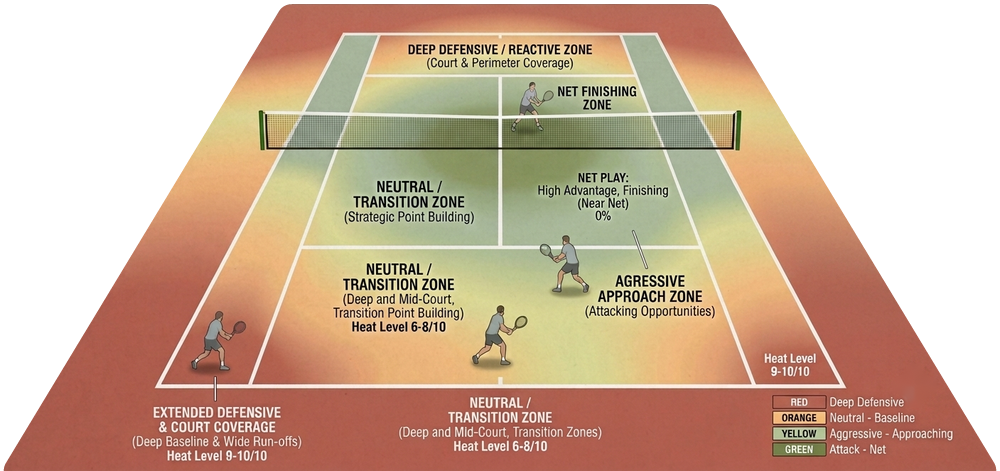
Court Position Zones

Behind the baseline: defensive. At the baseline: neutral. Inside the baseline: attack. Know where you are and match your shot selection to it. Attacking from behind the baseline usually means going for too much too early.

Serve + 1

Your serve gives you complete control. Use it to set up the next shot — ideally an attacking forehand. Have a plan before you walk to the line: where are you serving, and what do you want with the next ball?

05 — Serve

The One Shot You Control Completely

The serve is the only moment in a point where your opponent has no say. Use it to set the tone, not just start the rally.

Your Serve Routine

Decide where you're serving → three ball bounces → breath on the toss → full committed swing with momentum into the court. Don't abbreviate under pressure — lean on it harder.

01

Decision Before the Line

Where are you serving — wide, body, T? Decide before you approach the baseline. Walking up without a plan leads to last-second aim adjustments and rushed tosses. The routine only works if the decision comes first.

02

Consistent Toss = Consistent Serve

Every fault traces back to the toss. A toss slightly in front of your hitting shoulder gives you time to accelerate fully through the ball. Practice your toss in isolation — it's the most underrated practice habit for serve improvement.

03

Commit Fully — No Half Swings

A tentative serve is actually harder to control than a full one. Commit to the swing with full momentum. Playing it "safe" by slowing the swing down tends to produce more faults, not fewer — and gives your opponent a sitter.

04

Use the Routine as a Reset

When the match tightens — big points, broken games, tight sets — the serve routine becomes a mental anchor, not just a mechanical habit. Slow down between points, run the routine deliberately, and reset your focus.

05

Placement Over Power

Serving to a specific target — wide to the backhand, T on the deuce, body jammer on the ad — creates more free points than raw pace. Use different locations to keep your opponent guessing and set up your Serve + 1 patterns.

07 — Warm-Up Protocol

Arrive Ready, Not Rusty

A structured pre-match warm-up does two things: gets your body physically primed and narrows your focus from "outcome" to "execution" before the first point starts.

The Principle

Don't use the warm-up to groove new technique. Use it to confirm what you already have. Familiar patterns build confidence — unfamiliar ones build doubt.

1

Movement & Activation

3 min

Get blood flowing and loosen joints before you touch a racket. This is about the body, not the mind — save mental prep for step 3.

  • Light jog around the court perimeter — 2 laps
  • Lateral shuffles baseline to baseline — 2 sets each direction
  • High knees, leg swings, arm circles — 30 seconds each
  • Shoulder and wrist rotations — these take the most serve stress
2

Groundstroke Rally — Slow Build

4 min

Start from the service line, not the baseline. Short, controlled exchanges. Work your way back as timing arrives — don't start at full speed.

  • Service line mini-rally — feel the ball on the strings
  • Move to three-quarter court — add a bit of pace
  • Full baseline — crosscourt forehand then backhand patterns
  • Focus: watch the ball, stable finish. Not power, not placement
  • One down-the-line each side to confirm direction control
3

Mental Preparation

2 min

While you're rallying or between groundstroke reps, narrow your focus. This is where you set your intention for the match — not a to-do list, just one or two anchors.

  • 3 slow deep breaths — in through nose, out through mouth
  • Name your two cues for today: e.g. "eyes early" + "stable finish"
  • Remind yourself: play one point at a time, trust the patterns
  • Don't think about the score, the opponent's ranking, or outcomes
4

Volleys & Net Play

2 min

Get comfortable at the net. Even if you don't plan to come in much — volleys in warmup sharpen reflexes and touch for the whole match.

  • Forehand and backhand volleys — partner feeds from baseline
  • Focus: compact punch, contact out in front, firm wrist
  • One or two overheads if your partner can lob
5

Serve Warm-Up

3 min

Run your full serve routine from the first ball. Don't just bash serves — treat each one like a match serve. This is where the routine gets locked in before points start.

  • First 4 serves: slow, focused on toss and rhythm only
  • Next 4 serves: full swing, different targets (T, wide, body)
  • 2–3 second serves: commit to spin and placement
  • Finish with your favourite serve — leave on a good one
6

Return of Serve

2 min

Return a few serves from your opponent or partner. Read the ball, stay planted, compact backswing. Reminds your body of the return timing before the match starts.

  • Stay planted — don't over-move before contact
  • Block/redirect first serves back crosscourt
  • Step in and attack second serve returns
  • Note any toss patterns or serve tendencies early

08 — Between-Point Reset

The 20-Second Window

Between points is when matches are actually won and lost. The reset sequence keeps you in the present, prevents spiraling, and gives your nervous system a reliable signal to settle before the next point starts.

The Core Idea

You have ~20 seconds between points. That's enough time to process what happened, let it go, and arrive at the next point focused. The players who use that window well are the ones who hold leads.

Universal Reset Sequence
Step 1
🎾

Physical Release

One deliberate action — shake out your hand, adjust your strings, bounce on your toes. Breaks the mental loop from the last point.

Step 2
👁️

Look Away

Look down at your strings or toward the back fence. Not at your opponent, not at the score. Give your brain a visual break.

Step 3
💨

One Breath

Slow exhale through the mouth. This is your reset trigger. One breath is enough — don't over-ritualize it, just use it.

Step 4
🎯

Set Your Intention

One thought for the next point: your cue ("eyes early"), a target ("serve wide"), or just "next ball." Walk to the line with that thought only.

Scenario Playbook

😤 After Losing a Point You Should Have Won

Physical release first — shake it out. Acknowledge it happened, then consciously let it go. Ask yourself: "What's my cue for the next point?" Not "why did I miss that?" The error is done; the next point isn't.

✅ After Winning a Point

Brief acknowledgement — a fist pump, a word to yourself — then reset exactly the same way as after a lost point. Staying even-keeled after wins prevents complacency and overconfidence that leads to the next error.

🔥 On a Big Point (Break Point, Set Point, Tiebreak)

Slow everything down deliberately. Take the full time allowed. Run your serve routine completely — especially the three ball bounces and breath. If you're returning, move your feet on the baseline and take a breath before the server tosses. The extra second of calm is worth more than any technical adjustment.

📉 When You're Losing and the Match Is Slipping

Shrink the goal: win the next point, not the set or match. Look for one simple tactical adjustment — target their backhand more, vary the pace — and commit to it for 3 points before judging if it's working. Don't change everything at once.

🤫 When You're Ahead and Trying to Close

The biggest trap: serving it out or closing out a set is when routines get abbreviated and errors spike. Lean on your routine harder here. "Play your game, not the scoreboard" — your patterns got you to this point, keep running them.

Player Type Profiler

What Kind of Player Are You?

Answer 6 questions to identify your player type, then explore strengths, weaknesses, and how to match up against every other style. The AI coach also uses this to personalise answers to your questions.

Find Your Player Type

Answer honestly based on how you actually play, not how you'd like to play.

1. Where do you feel most comfortable in a rally?
2. What's your biggest weapon?
3. How do you try to win most points?
4. What happens when you're under pressure?
5. What part of your game do opponents find hardest to deal with?
6. What's your biggest weakness?

Your Player Type

✅ Strengths

    ⚠️ Weaknesses

      🎯 Key Tactic

        🔥 Toughest Matchup

          All Player Types

          Aggressive Baseliner

          The Hitter

          Wins points with pace and spin from the baseline. Takes the ball early, hits heavy and deep, and looks to dominate rallies through power. Dictates with the forehand.

          Strengths
          • Heavy groundstrokes create errors
          • Dictates rally tempo
          • Powerful forehand weapon
          • Wins short rallies outright
          Weaknesses
          • Can overhit under pressure
          • Vulnerable to pace variation
          • Struggles with high kick to backhand
          • Net play often underdeveloped
          Toughest Matchup

          Counterpunchers — they absorb pace and make the baseliner beat themselves with unforced errors.

          🎭

          All-Court Player

          The Versatile

          Uses every part of the court and a full shot toolkit. Comfortable at the baseline and net. Can shift game plans mid-match and exploit opponents' patterns.

          Strengths
          • Hard to read — huge variety
          • Adapts to any opponent
          • Effective serve + volley option
          • Controls point construction
          Weaknesses
          • May lack one dominant weapon
          • Can hesitate on decisions
          • Needs high tactical IQ
          • Inconsistency in transitions
          Toughest Matchup

          Big servers who take away time — variety is harder when you're on the back foot before you've started.

          🏹

          Serve & Volley

          The Net Rusher

          Wins points on serve or immediately after. Attacks the net constantly, uses court geometry, and puts pressure on opponents to pass under duress. Time is the weapon.

          Strengths
          • Takes time away from opponent
          • Dominant on fast surfaces
          • Strong serve wins free points
          • Angles and volleys hard to pass
          Weaknesses
          • Exposed when serve misfires
          • Lobs and passing shots effective
          • Struggles on clay or slow courts
          • Difficult to execute consistently
          Toughest Matchup

          Counterpunchers with great passing shots and lobs — they turn net rushing into a liability.

          🛡️

          Counterpuncher

          The Retriever

          Wins by getting everything back and forcing opponents to beat themselves. Exceptional court coverage, iron mental game, and the ability to turn defence into attack on the right ball.

          Strengths
          • Near-impossible to beat outright
          • Excellent under pressure
          • Mental toughness is elite
          • Topspin lob a constant threat
          Weaknesses
          • Passive — waits too long to attack
          • Struggles against big hitters
          • Points drag long — mentally tiring
          • Net game often underdeveloped
          Toughest Matchup

          Aggressive baseliners who can sustain pace and spin without errors — eventually forcing a short ball.

          🌀

          Moonballer

          The Disruptor

          Uses extreme topspin to hit high, heavy balls that push opponents deep. A variant of the counterpuncher but more offensive — the goal is to win points with the bounce, not just consistency.

          Strengths
          • Disrupts hitters' rhythm
          • Effective on clay
          • High margin over the net
          • Creates awkward high balls
          Weaknesses
          • Slow pace — opponent has time
          • Short balls punished severely
          • Predictable once read
          • Less effective on fast surfaces
          Toughest Matchup

          All-court players who step inside the baseline and take the ball early before it bounces high.

          🚀

          Big Server

          The Ace Machine

          Game revolves around the serve. Free points on serve reduce pressure on groundstrokes. Controls tempo from the very first shot of every point, dictating before the rally begins.

          Strengths
          • Free points reduce rally pressure
          • Sets up Serve+1 patterns
          • Controls game tempo entirely
          • Dominant on fast surfaces
          Weaknesses
          • Second serve can be exploited
          • Return games harder without serve
          • Groundstrokes may lag behind
          • Struggles on slow surfaces
          Toughest Matchup

          Strong returners who take the second serve early — removes the biggest weapon and makes hold difficult.

          Rally Building Strategy

          Stay In. Wait. Strike.

          The most reliable path to winning points at club level isn't the big shot — it's staying in the rally long enough for a clear opportunity to appear, then taking it decisively.

          The Core Principle

          70% of points at recreational level end in unforced errors. Your opponent will beat themselves if you stay in long enough. The job is to build pressure safely, recognise when an opportunity appears, and take it — not to force the issue early.

          🔑

          The Three-Phase Point Framework

          Phase 1 — Build: Keep the ball deep and crosscourt. No risk. Force your opponent back and wait for the pattern to develop.
          Phase 2 — Shift: When a shorter or weaker ball arrives, change direction or take time away. Apply pressure without going for the winner yet.
          Phase 3 — Strike: When the opportunity is clear — a short ball inside the court, an open court, an off-balance opponent — commit fully and finish the point.

          01

          Define What an "Opportunity" Actually Looks Like

          Don't attack vague situations. A clear opportunity is: ball lands short of the service line, opponent is out of position, you're inside the baseline, or the ball is at comfortable waist height with time to load. If none of those are true, reset and keep building.

          02

          Neutral Ball vs Attack Ball — Know the Difference

          A neutral ball is any ball that doesn't give you a clear advantage or disadvantage — deep, back to the middle. An attack ball is one where you've been given time, position, or a short landing. Use neutral balls to stay in the rally; use attack balls to end it. Most errors come from treating neutral balls as attack opportunities.

          03

          Go Crosscourt Until You Have an Opening

          Crosscourt is your highest-percentage rally shot — more net clearance, longer court, and keeps you central. Stay crosscourt in neutral situations. Down the line is an attacking shot reserved for when you're in position and the angle is there. The error most club players make: hitting DTL from a neutral position.

          04

          Use Depth as a Weapon, Not Just a Safety Net

          Every deep ball pushes your opponent behind the baseline. Behind the baseline, they have less angle, less time, and can't attack effectively. Consistently hitting 1–2 feet inside the baseline builds pressure without risk. It's not a defensive move — it's point construction.

          05

          Change Direction Only When Loaded

          Changing the ball's direction — hitting crosscourt to down-the-line — is inherently harder than redirecting the same direction. Only change direction when you're fully loaded with time to execute. In a scramble, keep the ball going in the direction it came from. Emergency DTL attempts cause most wide errors.

          06

          The Patience Test: Count to Three

          Before attacking, have you hit at least 2–3 good deep balls first? If not, you're attacking too early. Build the point to at least three shots before the opportunity materialises. In practice, set a rule: don't go for a winner until you've landed two consecutive deep crosscourt balls. Watch how your error rate drops.

          07

          Recover After Every Shot

          Rally building only works if you're in position for the next ball. After every shot — including the one you just attacked with — recover to your base position (roughly the centre of where your opponent can realistically return). Many rally breakdowns aren't about the shot you hit; they're about where you were for the next one.

          08

          When to Abandon the Plan and Reset

          If you're pulled wide, pushed back deep, or forced into a bad position — the point is in defence. Reset with a heavy topspin ball back down the middle. Don't try to win a point you're losing. Get back to neutral first, then start the build again from Phase 1.

          Rally Building by Player Type

          Aggressive Baseliner

          Use rally building to set up your forehand. Get to Phase 2 via crosscourt backhand depth, then run around and attack with your forehand when the short ball comes. Don't force your forehand from neutral position — earn it.

          🎭

          All-Court Player

          Rally building is your natural game. Build crosscourt, then introduce a surprise slice, DTL, or approach at Phase 2 to create the Phase 3 opportunity. Your variety is the weapon — save it for the right moment.

          🛡️

          Counterpuncher

          You're great at Phases 1 and 2 but struggle to pull the trigger at Phase 3. Work on recognising clear attack opportunities and committing fully instead of resetting again. One more defensive ball in a Phase 3 situation is a missed chance.

          🏹

          Serve & Volley

          Your Phases 1–3 happen in 1–2 shots: serve sets up Phase 3 directly. When rallies do develop, use short, compact rally building (1–2 balls) before approaching — don't get stuck in extended baseline exchanges.

          09 — Match Journal

          Track Your Progress

          Log your matches here. Over time you'll see patterns — where you win, where you lose, and what consistently breaks down. Entries are saved in your browser.

          No entries yet Log your first match above — entries are saved locally in your browser.

          10 — Coaches Corner

          Wisdom From the Best Minds in Tennis

          Key principles and publicly shared insights from the world's top coaches — distilled into actionable tips you can take straight to the court.

          CO
          Craig O'Shannessy
          Strategy Analyst · ATP Tour, Wimbledon, NY Times
          Novak Djokovic Matteo Berrettini Kevin Anderson
          📊
          The First 4 Shots Win Matches70% of points end in 4 shots or fewer. Serve, return, serve +1, return +1 — these are the shots that matter most, yet get practiced least. If you only grind long baseline rallies in practice, you're training for 10% of your match.
          🎯
          Tennis Is Patterns, Not ChaosThe court looks like pinball, but it's actually a game of repeatable patterns in four areas: serving, returning, rallying, and approaching. Study where your patterns win and lose — data, not feeling.
          📐
          The 2-1 PatternPush deep to position C (opponent's backhand baseline corner), step in when they give you a shorter ball, then go wide to position D to open the court. This is statistically the most reliable baseline pattern at every level.
          💡
          Practice What Your Match Actually Looks LikeMost club players practice 10+ shot rallies. Most points end in 1–4 shots. Rebuild your practice sessions around short point construction — serve, serve+1, return, return+1.
          DC
          Darren Cahill
          Elite Performance Coach · ATP Tour
          Jannik Sinner Andre Agassi Simona Halep
          🎨
          Add Shape and VariationDjokovic's insight on Sinner: flat, predictable ball with no height variation. Great players mix shape — topspin, slice, height over the net, pace changes. If your shots are one-dimensional, even if technically clean, opponents adjust fast.
          🧠
          Players Don't Believe It Until They Feel ItInformation from a coach only sticks when a player internalises it on court. Hearing advice isn't enough — you need reps under match conditions before a change truly lands. Give new things time before judging them.
          💪
          Resilience Is Built Through ExperienceMental toughness isn't given — it's built through going through hard moments and coming out the other side. Seek out tough matches, not easy wins. The uncomfortable situations are where character is formed.
          🔄
          Attack the Return of ServeMost players are too passive on the return. Especially on second serves — step in, take the ball early, and take time away from the server. Don't let the server dictate every point from shot one.
          BG
          Brad Gilbert
          Coach & ESPN Analyst · Author of Winning Ugly
          Andre Agassi Andy Roddick Andy Murray Coco Gauff
          🏆
          Winning UglyFind any possible way to win — with what you have, on that day. Beautiful tennis that loses is still a loss. Ugly tennis that wins is still a win. Adapt your game to the conditions and your opponent, not to a perfect ideal.
          🔍
          Scout Your Opponent Every MatchWatch the warm-up carefully. Find their weaker wing, their pattern under pressure, their emotional triggers. Most players play the same way regardless of opponent — the ones who adapt are the ones who win close matches.
          🧭
          Have a Mental CompassBefore each match, create a clear game plan and commit to it for at least 3–4 games before changing. "Brain-dead tennis" — playing without a plan — is how most matches are lost, not by being outplayed.
          ⏱️
          Don't Rush MeControl your own tempo between points. Slow things down when the match is tight. The server controls pace — use it. Take your full time; don't let the opponent dictate your rhythm.
          NB
          Nick Bollettieri
          Founder, IMG Bollettieri Tennis Academy
          Andre Agassi Serena Williams Maria Sharapova Boris Becker
          🔥
          Intensity Is a SkillDiscipline and preparation create intensity. It's not something you either have or don't — it's built through habits. Show up with the same energy in practice as you expect to have in a match, or you won't find it when it counts.
          📖
          Every Loss Is a LessonFear of losing visibly shrinks reliable strokes under pressure. Separate the outcome from the performance. What did the loss teach you? Players who process losses as data improve faster than those who avoid the feeling.
          👁️
          Read Your Opponent in the Warm-UpYou can learn everything you need to know about an opponent before the match starts. Tendencies, patterns, how they handle short balls, their movement, their weaker wing. Warm-up is intel-gathering time.
          🏃
          Master Difficult Situations on the RunYour technique in a controlled rally is only half the story. The shots that decide matches are hit under pressure, on the move, off-balance. Build those skills deliberately — practice difficult positions, not just comfortable ones.
          PM
          Patrick Mouratoglou
          Founder, Mouratoglou Academy · UTS Founder
          Serena Williams Holger Rune Stefanos Tsitsipas
          🎯
          The Follow-Through Is Not OptionalThe accompaniment after contact — the follow-through — ensures fluidity and transmits the power built by your body into the ball. Cutting it short is cutting your shot short. Let the racket finish naturally, every single time.
          🦶
          Foot Placement and Chest Orientation Are EverythingWhere your feet point and where your chest faces at contact determines where the ball goes. Good footwork isn't about speed — it's about getting into the right position so the upper body can do its job.
          🧩
          Adapt Technique to Your StyleThere is no single "correct" forehand or serve. A western grip works for heavy topspin; eastern for flat drives. The grip, stance, and swing path should match the game you're trying to build — not a generic model.
          📈
          Coaching Is Asking Questions, Not Giving AnswersThe best coaching doesn't tell players what to do — it asks questions that lead them to discover the answer themselves. What you discover yourself, you believe. What you're told, you question.
          JH
          Jose Higueras
          USTA Director of Coaching · Former Top 10 Pro
          Jim Courier Michael Chang Pete Sampras Roger Federer
          🏗️
          Build Points DeliberatelyTennis is construction, not demolition. Don't try to end points early — build them. Each shot should make the next shot easier. Patience in point construction is what separates 4.0 from 4.5 players.
          🎓
          Fundamentals Before WeaponsA reliable, consistent groundstroke is more valuable than an occasional spectacular winner. Build the weapon on top of a consistent foundation — not instead of it.
          🔁
          Repetition With IntentThere's a difference between hitting balls and practicing. Every ball you hit should have a purpose: a target, a spin, a pattern you're building. Mindless repetition builds mindless tennis.
          🌍
          Clay Court Mentality on Any SurfaceClay teaches patience and construction. Even on hard courts, thinking like a clay court player — building points, high margin, depth before angles — produces more consistent results than trying to blast through every ball.
          🎾 Specifically for Recreational Players

          These coaches have explicitly stated that their systems and philosophies apply to all levels — not just the pros. Here's what they say directly to club and rec players.

          Craig O'Shannessy

          Stop Grinding Long Rallies in Practice

          70% of your match points end in 4 shots or fewer — yet most rec players spend 90% of practice time grinding baselines. Rebuild your practice around serves, returns, and serve+1. That's where your matches actually happen.

          Craig O'Shannessy

          Most Points Are Lost, Not Won

          At recreational level, 70%+ of points end in an unforced error, not a winner. Your job isn't to hit winners — it's to avoid giving points away. One more ball in play beats one spectacular shot that goes out.

          Brad Gilbert

          You Don't Have to Play Better — Just Smarter

          Winning Ugly is specifically written for rec players. You don't need to hit like a pro. You need to observe your opponent, exploit their weakness, and execute your own game with intent. Strategy beats raw talent at club level, every time.

          Brad Gilbert

          Most Rec Players Have No Game Plan

          "Brain-dead tennis" — walking on court with no plan — is how most club matches are lost. Decide before you play: what's your opponent's weaker wing? How will you serve? Which pattern will you use? Even a simple plan beats no plan.

          Nick Bollettieri

          8 Simple Ways to Instantly Improve

          Shorten your backswing, use your non-dominant hand in prep, lengthen your follow-through, and say "bounce / hit" to stay focused. Bollettieri said these four changes alone will immediately make any rec player more consistent.

          Darren Cahill

          Information Doesn't Stick Until You Feel It

          If your coach gives you a tip and it doesn't work the first session — don't abandon it. You need reps under real conditions before a change lands in your body. Give it at least 3–4 sessions before judging whether it's working.

          Patrick Mouratoglou

          Fundamentals Beat Technique

          Footwork, early preparation, unit turn, and split step will take you 99% of the way as a rec player. Fancy swing mechanics don't matter if you're arriving late to the ball. Get your feet right first — everything else follows.

          Jose Higueras

          Practice With a Purpose Every Ball

          There's no improvement in hitting balls with no intention. Every ball should have a target, a pattern, or a specific thing you're working on. Mindless rallying builds mindless match play. Use your practice time like it costs something.

          11 — Ratings Guide

          NTRP, UTR & What They Actually Mean

          Two systems, very different purposes. Here's how they compare, what each level looks like on court, and which one matters for what.

          No Official Conversion Exists

          NTRP and UTR measure different things. The table below is based on widely used community estimates — treat the UTR ranges as approximations, not guarantees. A men's 4.0 NTRP typically maps around UTR 6.0–8.0 depending on recent match results.

          Level NTRP UTR (Men) UTR (Women) What this player looks like
          Beginner 2.5 2.0 – 4.0 1.5 – 3.5 Learning to keep the ball in play. Inconsistent groundstrokes, no reliable serve, limited court coverage.
          Recreational 3.0 3.5 – 5.5 3.0 – 5.0 Can sustain medium-paced rallies. Developing direction and depth. Not yet comfortable under pressure. Most common club level.
          Recreational 3.5 4.5 – 6.5 4.0 – 6.0 Improved stroke dependability. Some spin and variation. More aggressive net play. Starting to use tactics. Developing doubles teamwork.
          Intermediate 4.0 6.0 – 8.0 5.5 – 7.5 Dependable strokes on both wings. Uses lobs, overheads, approach shots, volleys with some ease. Begins to force errors on serve. Can lose points due to impatience.
          Intermediate 4.5 7.5 – 9.5 6.5 – 8.5 Beginning to master power and spin. Reliable footwork. Controls depth. Can approach the net on serve. Tactical awareness. Often overhits under pressure.
          Advanced 5.0 9.0 – 11.0 8.0 – 10.0 Strong anticipation. One outstanding shot or exceptional consistency. Regularly hits winners off short balls. Executes all shots including drops, lobs, smashes. Good second serve depth and spin.
          Advanced 5.5 10.0 – 12.0 9.0 – 11.0 Power and/or consistency as a major weapon. Can vary strategy mid-match. Dependable shots under stress. Former high school or college varsity player.
          Elite / Pro 6.0 – 7.0 12.0 – 16.5 11.0 – 16.5 National/international tournament experience. College scholarship level and above. ATP/WTA ranked professionals sit at 13–16.5.
          UTR Scale Visualised
          2–4
          Beginner (NTRP 2.5)
          4–6.5
          Recreational (NTRP 3.0–3.5)
          6–9.5
          Intermediate (NTRP 4.0–4.5)
          9–12
          Advanced (NTRP 5.0–5.5)
          12–16.5
          Elite / Pro (NTRP 6.0–7.0)
          NTRP vs UTR — Key Differences

          📏 How They Measure

          The two systems are built on fundamentally different logic and serve different purposes. Neither is wrong — they just measure different things.

          NTRP
          • Fixed brackets (2.5, 3.0, 3.5...)
          • Season-end calculation
          • Win/loss based, not margin-based
          • US-centric, league-focused
          • Hidden dynamic rating during season
          UTR
          • Decimal scale 1.00–16.5
          • Updates after every match
          • Margin-based (6-0 moves it more than 7-6)
          • Global, age/gender neutral
          • Standard for US college recruiting

          ⚡ Which Updates Faster

          UTR recalculates within hours of a match result being uploaded. NTRP updates only at year-end for most players — meaning a 3.5 who's been dominating all year will still show as 3.5 until the next rating cycle. UTR captures improvement in real time; NTRP captures your level at the end of the season.

          🎯 When to Use Which

          Use NTRP when...
          • Playing USTA league matches
          • Entering USTA-sanctioned tournaments
          • Finding a practice partner at your club
          • Describing your level to most US rec players
          Use UTR when...
          • Pursuing college tennis recruiting
          • Playing international tournaments
          • Tracking improvement match-by-match
          • Finding opponents globally via UTR platform

          ⚠️ The Gender Difference in UTR

          At the same NTRP number, women typically carry a lower UTR than men. A women's 4.0 NTRP generally maps to a lower UTR than a men's 4.0. This is because UTR is a single universal scale — it's not separated by gender. When comparing UTRs across genders, factor in roughly a 1–1.5 point adjustment.